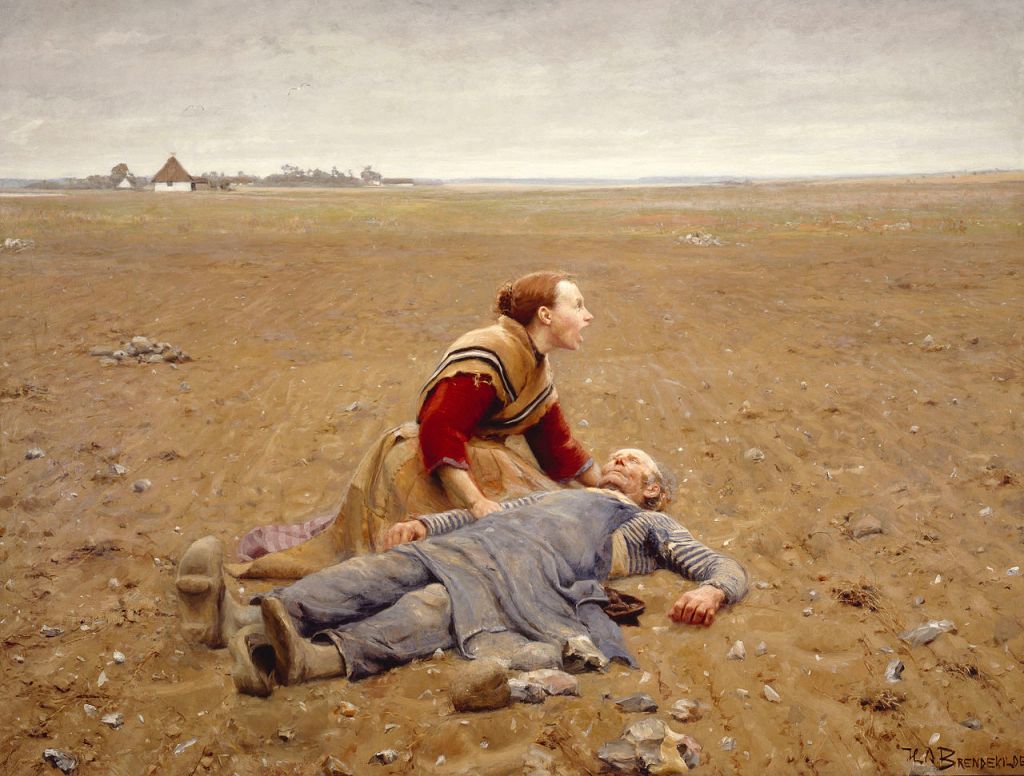
In the middle of a field in Denmark, a woman calls out for help, her husband has finally succumbed to many years of hard labor, and died in the same field in which he worked for the majority of his life. In the critically acclaimed painting on the right by H.A. Brendekilde, we see the harsh reality of how life ended for many peasants. Even though the focus of this post is about the 18th century, and the painting relates to the conditions of the 19th century, I still wanted to include it. For what is the history of the Danish peasantry during the 17th century, but a tale of turmoil, destitute conditions, and gruesome work. In this post, i will be focusing on Denmark, relative to Norway and Sweden, during the years immediately before the French revolution 1789.
It is evident that even before the long 19th century, (understood as spanning from roughly 1789 to 1914) the majority and the bulk of the population in all of Scandinavia were peasants. It’s estimated that only 20% of the Danish population lived in cities at the turn of the 19th century.1 With only 10% of Denmarks personal union partner Norway in the same situation.2 Comparatively, Sweden was estimated to have about the same urban population as Norway, at around only about 10% of their people living in cities, or outside of rural communities.3
Denmark had in the years leading up to the turn of the 18th century, been characterized by a serfdom like institution, enforced by a law known as “Stavnsbåndet”, which translates roughly to “home-bondage”. This legal code, was aimed at preventing lack of mobility for peasants in the Kingdom of Denmark, binding the farmers to their local area, and ensuring the nobility a workforce for their agricultural lands. This was, however, not the main purpose of the law, which was instead, to supply the kingdom a militia made up of the peasantry, which had trained and was ready to be mobilized, in case of war. The laws effectively bound males from childhood until the age of 40 to their local area, unless they were needed for military service. Due to the very serious threats of war, it was not unheard of, that the peasants to maim themselves, in order to avoid military service. This home-bondage institution only affected Denmark-proper, and was not enforced in Norway, which until 1813 was under the dominion of Denmark.
The iron grip of the king under his absolute rule, held power over the peasantry and remaining population. The nobility, which had the responsibility of producing profit from the peasants, had several methods of extracting this from them. Their labor was extensively exploited, and conditions were generally harsher in Zealand than in Jutland and Funen. Corporal punishment was common, and torture of peasants due to poor work effectiveness, was a part of daily life, although it was illegal to directly kill or maim the peasantry.4
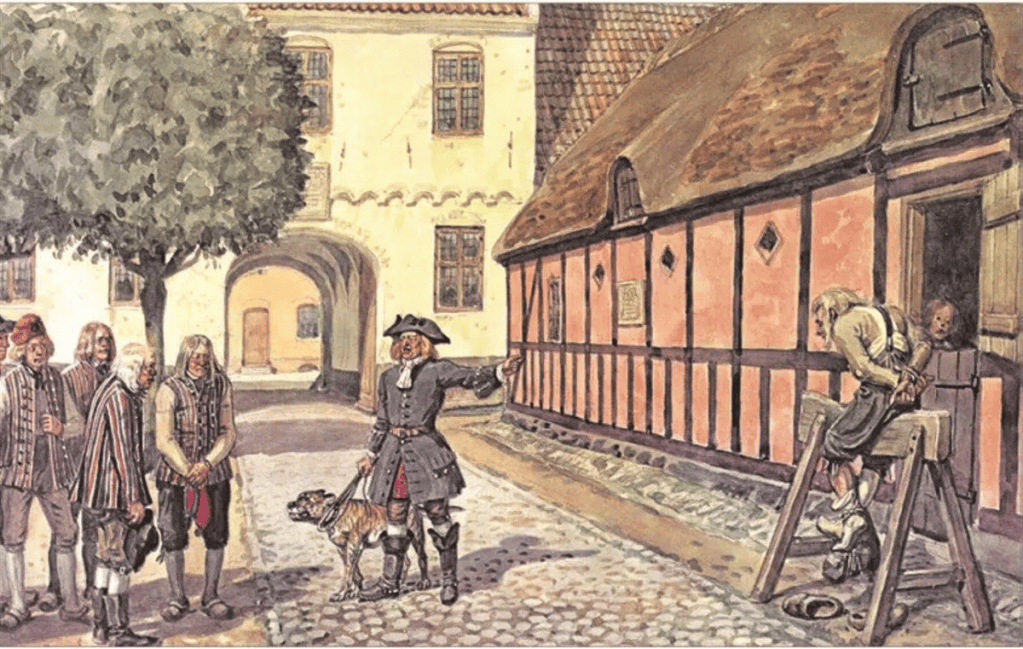
(Painting by Rasmus Christiansen)
The understanding of the peasant as simple and unable to comprehend complicated thought, was engrained in the higher levels of not only Danish, but European society, understood as “homo-rusticus”. The peasant simply did not need or have the same legal rights as the more civilized burghers, merchants, and other city-folk. the nobility and other social classes did not think much of their agrarian workforce. In Peter Henningsen book “Stavnsbåndet”, he produces a quote by a unnamed district bailiff in Zealand in the year 1829, which portrays “homo-rusticus”:
“The peasant’s present level of of the arts, is of such a low level, his train of thought so small, his point of view so narrow, his morality and religiosity so weak, that another age of man will pass, before he can act among his cultured kin, with the enlightenments true zeal.”5
After the gradual abolishment of the serfdom like institution at the end of the 18th century, due to concerns over the practice, the Danish peasants began experiencing gradual changes in their daily life, due to a multitude of agricultural reforms. This meant, for example, that many of the peasantry, who previously did not have property rights, became landowners, and their children were sent to schools, all to increase productivity. Although a law enforcing the right for education with regards to reading, was established already in the year 1739, it focused exclusively on religious bible teaching, and the teaching of writing and mathematics were not included, unless payment was made.6 The ability to leave the countryside due to the allowance of free movement created a large shift in the demographics of the nation, and along with the rest of the European kingdoms, industrialization in the middle of the 19th century, led to large amounts of urbanization and the gradual removal of the peasantry as a large social class.
Despite the loss of territory in 1814, consisting of Norway, which made up half the population of the Kingdom of Denmark-Norway, and Denmark later loss of Schleswig-Holstein in 1864, which was approximately a third of the the Denmarks population at the time. The change from the peasantry being landless and in a serf-like state, to ownership of their property, along with education reforms, created the framework for the later Danish cooperative movement, which some would say, ensured that Denmark became the economically prosperous nation we know today.
If you have any questions for the footnotes, or for further reading, or just comments, feel free to write.
- Hans Christian Johansen, Befolkningen – Danmark i tal i Gyldendal og
Politikens Danmarkshistorie på lex.dk ↩︎ - https://www.norgeshistorie.no/industrialisering-og-demokrati/1524-byene-vokser.html ↩︎
- Erik Bengtsson and Patrick Svensson, “The living standards of the labouring classes in Sweden, 1750–1900: evidence from rural probate inventories” ↩︎
- Peter Henningsen, Stavnsbåndet, (Aarhus Universitetsforlag, 2020) ↩︎
- Peter Henningsen, Stavnsbåndet, (Aarhus Universitetsforlag, 2020) ↩︎
- Charlotte Appel, Alle skal kunne læse (Aarhus Universitetsforlag, 2026) ↩︎


Leave a comment